What Is the Average Salary for Marketing Majors?

So, you've got your marketing degree—or you're about to. Now for the big question: what can you actually expect to earn?
Right out of the gate, the average salary for marketing majors in the United States hovers around $67,990 per year for entry-level jobs. That number isn't just a base salary; it often includes bonuses and other compensation. But treat that figure as a starting point, not a guarantee. Your actual paycheck will be shaped by the specific job you land, the industry you enter, and where you put down roots.
Decoding Your Earning Potential After Graduation
Graduating with a marketing degree is a bit like being handed a map. You have a destination in mind—a great career—but there are countless routes to get there. That "average salary" is just one landmark on the map; it doesn't show you the terrain.
Think of your starting salary as a flexible baseline, not a fixed number. A few key factors will immediately nudge that baseline up or down, creating a realistic range for what you can expect to earn. Understanding these variables is your first step to getting paid what you're worth.
Key Factors Shaping Your First Paycheck
The three biggest dials that control your starting salary are your job title, the industry you work in, and your location. Each one pulls your potential earnings in a different direction.
- Your First Role: Not all "entry-level" marketing jobs are created equal. A Marketing Coordinator role, for instance, typically has a different pay scale than a more specialized Digital Marketing Specialist, even if they both require a fresh degree.
- The Industry: A marketing gig at a high-growth tech company will almost certainly come with a different salary and benefits package than a similar position at a non-profit or a government agency.
- Geographic Location: This one’s a biggie. The cost of living and the local demand for marketing skills create huge salary gaps between major hubs like San Francisco and smaller cities.
Let's put some real numbers to this. Recent data shows that new marketing grads with a bachelor's degree can expect an average total compensation of around $67,990. This average is a blend of various roles, including Marketing Coordinators who start around $49,526 and Marketing Associates who earn closer to $51,688.
To give you an even clearer picture, we've broken down some of the most common first jobs for marketing majors and their typical starting salaries.
Entry-Level Marketing Salary Snapshot
Here's a look at what you can generally expect to make in some popular entry-level marketing positions. This should give you a more practical idea of where you might land.
| Job Title | Average Annual Salary Range |
|---|---|
| Marketing Coordinator | $45,000 - $60,000 |
| Social Media Specialist | $48,000 - $65,000 |
| SEO Specialist (Entry-Level) | $50,000 - $70,000 |
| Content Marketing Specialist | $52,000 - $68,000 |
| Marketing Associate | $50,000 - $65,000 |
These roles are fantastic launching pads for a successful career. For a more detailed breakdown of what each job entails and which might be the best fit for you, check out our guide on the best entry-level marketing jobs.
How Your Salary Grows with Experience
That first paycheck you get after graduating with a marketing degree? It's just the starting line. Think of it as setting the stage—the real action unfolds as you gain skills, take on bigger responsibilities, and start delivering results that actually move the needle for your company.
Your career path isn't just about putting in the years. It's about a fundamental shift from doing tasks to directing strategy. A new grad might spend their day scheduling social media posts. A seasoned director, on the other hand, is busy deciding which new platforms the company should bet on for the next five years.
Let's walk through what this journey looks like and how your salary can evolve at each stage. This infographic gives a great snapshot of the starting point, showing how the general average breaks down for common entry-level roles.
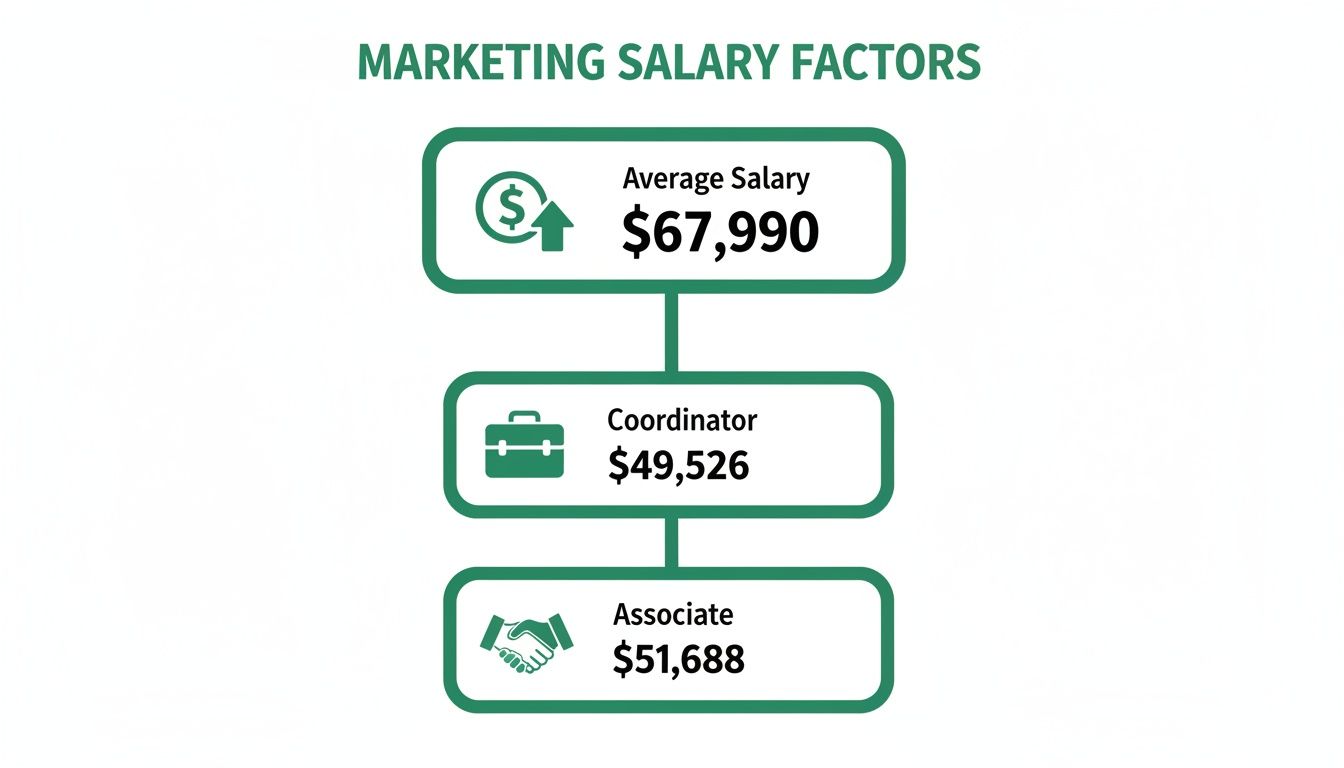
As you can see, even at the very beginning, a Marketing Coordinator and a Marketing Associate have their own distinct salary brackets. It's this specialization and growth in responsibility that really drives your earning potential forward.
The Foundational Years: Entry-Level (0–2 Years)
This is where you build your foundation. You’re in a learning-and-doing phase. Whether you're a Marketing Coordinator, Social Media Specialist, or Marketing Associate, your job is to get your hands dirty and master the basics. You're learning the software, figuring out campaign workflows, and proving you can get things done.
During this time, your salary growth is usually steady but not explosive. Companies are really investing in your potential. Your main goal should be to soak up everything you can and build a portfolio of work you can be proud of. A typical starting salary falls somewhere in the $45,000 to $65,000 range, though this can swing quite a bit based on your role, industry, and where you live.
The Strategic Phase: Mid-Level (3–7 Years)
After a few years of hands-on work, you’ll start transitioning from a doer to a planner. You're not just executing the plan anymore; you're helping to build it. This is when roles like Marketing Manager, SEO Strategist, or Senior Content Specialist open up. You'll be expected to manage projects from start to finish, analyze performance data, and have a real say in the team's overall strategy.
Your value shifts from just completing tasks to creating a measurable impact. Now, you can point to a campaign and say, "I led that, and it drove a 20% increase in leads."
Being able to connect your work directly to business goals is what triggers that first major jump in pay. Mid-level pros often pull in between $70,000 and $100,000+. If you’ve developed in-demand skills in areas like performance marketing or data analytics, you'll find yourself at the higher end of that spectrum. To get a better sense of this climb, checking out a detailed marketing career path roadmap can show you exactly what to expect.
The Leadership Phase: Senior-Level (8–15 Years)
At the senior level, your focus pivots again—this time from managing projects to managing people and entire programs. As a Senior Marketing Manager or Director of Marketing, you're now responsible for a whole marketing function. Your job is to build and lead a team, command a significant budget, and own the results for a key slice of the business.
Your pay structure often gets more complex here, too, with performance bonuses and other incentives becoming part of the package. The salary range for senior-level marketers typically lands between $100,000 and $160,000, and plenty of roles go well beyond that depending on the company and industry. At this point, your strategic vision and leadership skills are your most valuable assets.
The Visionary Tier: Executive-Level (15+ Years)
Once you reach the executive tier, you're no longer just running campaigns—you're shaping the future of the company’s brand and growth. Titles like Vice President (VP) of Marketing or Chief Marketing Officer (CMO) carry the immense responsibility of steering the company's market position and revenue engine.
Your role becomes almost purely strategic. You're focused on long-term planning, competitive positioning, and C-suite leadership. Naturally, the compensation reflects this level of accountability, often including a hefty base salary, large bonuses, and even an equity stake in the company.
Executive pay varies widely but generally starts around $170,000 and can easily sail past $250,000. Your career has officially evolved from managing a to-do list to steering the entire ship.
Which Marketing Specializations Earn the Most?
When you step into the world of marketing, you'll quickly find that not all paths lead to the same paycheck. While every specialization is crucial for a company's success, the market simply values certain skills more than others. This isn't a judgment on which job is "better"—it’s a straightforward reflection of supply, demand, and how closely a role is tied to bringing in revenue.
Think of a marketing department like a high-performance pit crew. You have the designers who create the car's stunning look (creative roles) and the PR team building buzz around the driver (communications). Both are absolutely vital. But then you have the engineers who are fine-tuning the engine for raw speed and efficiency (technical roles). In business, the people who can directly "tune the engine"—driving leads, sales, and measurable ROI—often command the highest salaries.
It's why technical, data-driven roles frequently out-earn their creative counterparts. If you can walk into a meeting and prove your work led to a $500,000 bump in sales, you've got some serious leverage when it's time to talk compensation.
The High-Demand Technical and Analytical Fields
Technical and data-focused roles are the new power players in marketing. These pros operate at the intersection of marketing strategy, technology, and business intelligence, and they're so valuable because their impact can be measured down to the dollar.
Here are some of the most lucrative specializations right now:
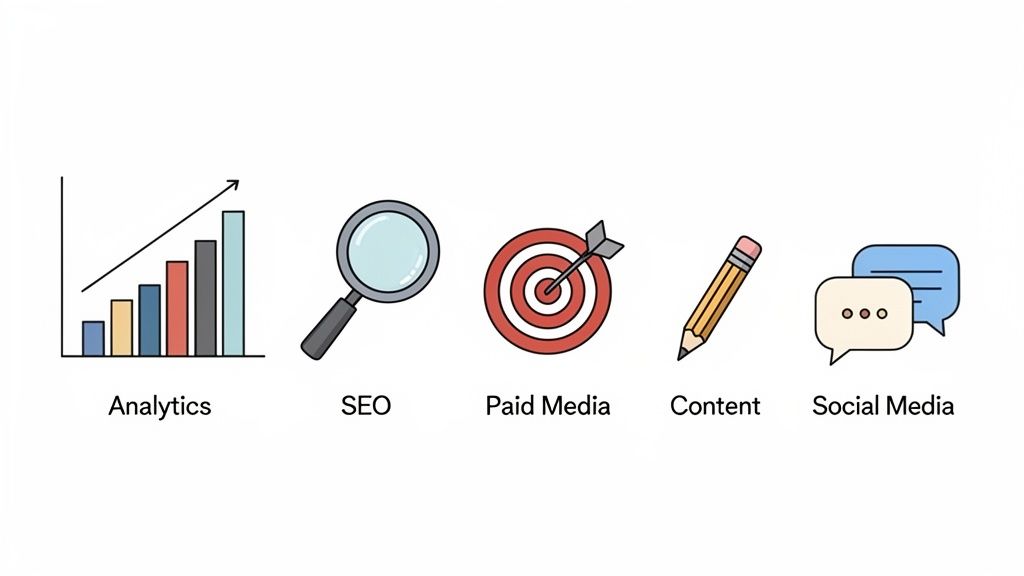
- Marketing Analytics: These are the data storytellers. They dig into complex numbers to figure out what customers are doing, whether campaigns are working, and where the next big opportunity lies. Since they guide multi-million dollar budget decisions, their expertise is a hot commodity.
- SEO/SEM Specialists: Search Engine Optimization (SEO) and Search Engine Marketing (SEM) specialists are masters of getting seen. They work to put their company at the top of Google, a position that translates directly into website traffic and sales.
- Paid Media and Performance Marketing: These are the marketers holding the purse strings for ad budgets. They live and breathe platforms like Google Ads and Meta Ads, and their success is judged by one core metric: Return on Ad Spend (ROAS).
These jobs require a unique mix of marketing intuition and hard skills in data analysis and specific software. That makes qualified candidates both rare and incredibly valuable.
The Essential Creative and Communications Roles
While the tech-focused roles might lead in pay, the creative and communication folks are the heart and soul of any brand. Their job is to build relationships, earn trust, and create the stuff that actually makes people pay attention.
Though the compensation can look different, their value is undeniable.
- Content Marketing: Great content is the fuel for every other marketing channel. These are the people creating the blog posts, videos, and guides that pull customers in. A great way to boost your value here is by learning skills like building effective content sales funnels, which directly connects your content to sales results.
- Social Media Marketing: Social media managers are the voice of the brand. They build communities and manage a company's reputation on the platforms where customers spend hours every single day.
- Public Relations (PR): PR pros shape how the public sees a company. They work to get positive press and build a strong image, which creates long-term trust that you just can't buy.
While a paid media specialist can show immediate ROI from an ad campaign, a PR specialist builds the brand reputation that makes those ads more effective in the first place. Both create immense value, just in different ways.
The salary gap often boils down to how easily the results can be measured. It’s a lot harder to put a precise dollar figure on a brilliant PR campaign than a successful pay-per-click ad, and that reality often shapes compensation.
Aligning Your Passion with Market Demand
The point here isn’t to ditch your creative passion for a more technical role. It’s about being strategic so you can maximize your earning potential, no matter which path you choose. The real key for any marketing major? A higher salary usually follows deeper specialization.
If you love creating content, become an expert in SEO-driven content strategy. If you're a natural on social media, dive into paid social advertising and analytics to prove your impact. By adding data-driven skills to your creative talent, you bridge that gap and become a much more indispensable—and better-paid—part of any team.
For a deeper dive into specific roles and what they earn, check out our guide to the highest-paying marketing jobs and see where your skills can take you.
How Your Location Impacts Your Paycheck
Your job title and experience level are obviously huge pieces of the salary puzzle, but there’s another variable that can have just as big of an impact: your zip code. Seriously. Where you live and work is just as important as what you do, and the average salary for a marketing major can swing wildly from one city to the next.
This isn't random. It’s all about two key economic forces. The first is the cost of living. A salary that lets you live comfortably in Austin might barely cover rent and groceries in San Francisco. To attract talent, companies in expensive cities simply have to pay more.
The second force is local market demand. Tech hubs like Seattle, New York, and the Bay Area are jam-packed with companies all fighting for the best marketing talent. That kind of competition naturally drives salaries up as businesses try to outbid each other for the skills they need.

A Tale of Two Cities
Let’s put this into perspective. Imagine two marketing managers with identical skills and experience. One works in San Jose, California, the heart of Silicon Valley, and the other is based in Kansas City, Missouri.
The marketer in San Jose might pull in $140,000, while their counterpart in Kansas City earns a respectable $95,000.
On paper, that $45,000 difference looks massive. But when you factor in that the cost of living in San Jose is over 80% higher than in Kansas City, the gap in their actual spending power shrinks dramatically. That higher salary in California isn't just a bonus; it's a necessity to cover the staggering costs of housing, gas, and everything else. This is exactly why looking at a national salary average without considering geography can be so misleading.
How Salaries Stack Up Across Major US Cities
The financial impact of location becomes crystal clear when you compare major cities side-by-side. The table below gives you a snapshot of what a mid-level marketing manager can expect to earn across the country, showing just how much local market conditions move the needle.
Marketing Manager Salary by US City (Cost of Living Adjusted)
| City | Average Annual Salary | Notes on Local Market |
|---|---|---|
| San Francisco, CA | $142,500 | The tech epicenter. An extremely high cost of living and fierce competition for talent push salaries to the absolute top. |
| New York, NY | $135,000 | A global hub for finance, media, and advertising. High demand and a sky-high cost of living keep paychecks fat. |
| Seattle, WA | $128,000 | Home to giants like Amazon and Microsoft, creating a competitive, high-paying market for tech-savvy marketers. |
| Boston, MA | $125,000 | A strong tech and biotech scene fuels a robust job market, with salaries that reflect the area's high living costs. |
| Austin, TX | $110,000 | A booming tech scene with a more moderate cost of living than the coastal hubs makes it a very attractive market. |
| Chicago, IL | $105,000 | A diverse economy with major corporate HQs provides solid marketing roles with salaries balanced by a more moderate cost of living. |
| Atlanta, GA | $102,000 | A growing business and media hub in the Southeast, offering competitive pay with a more affordable lifestyle. |
As you can see, there's a clear pattern. The biggest paychecks are found in the major tech and business hubs where both the demand for talent and the cost of living are through the roof.
Understanding your local market is non-negotiable. A national "average" salary is a useful benchmark, but your true market value is ultimately set by the supply and demand for your skills right where you live.
The Remote Work Wrinkle
The rise of remote work has thrown a fascinating curveball into salary conversations. If you live in a low-cost area but work for a company based in an expensive city, what should you be paid? Companies are still sorting this out, and their policies are all over the map.
Some have adopted a location-agnostic approach, paying the same salary for a role no matter where the employee is. Others adjust pay based on the employee's local cost of living. As a job seeker, this creates both opportunities and challenges. It's now more important than ever to get clear on a potential employer’s compensation philosophy for remote work early in the conversation.
Finding the Highest Paying Industries for Marketers
Your marketing degree is a bit like a passport—it can get you into just about any industry you can think of. From healthcare to high tech, every single sector needs sharp marketers to build a bridge to their customers. But let's be honest, when it comes to your paycheck, not all industries are created equal.
The salary you can expect marketing for a tech giant versus a local non-profit can be worlds apart. Understanding why is the first step to maximizing your career earnings. It really boils down to simple economics: industries with fat profit margins and a crystal-clear link between marketing campaigns and revenue can afford to pay top dollar for talent.
Industries with the Biggest Paychecks
Some sectors consistently pull ahead of the pack, offering the most attractive salaries for marketing pros. These are often fast-growing, hyper-competitive fields where marketing isn't just a side project—it's the main engine powering the whole business.
Technology (SaaS, Fintech, AI): Tech is the undisputed champion of high marketing salaries. Think about it: companies selling software, financial technology, or AI solutions have a massive customer lifetime value and depend almost entirely on savvy digital marketing to get them. A Product Marketing Manager in this world can easily pull in six figures because their work directly translates to sales and market dominance.
Pharmaceuticals and Healthcare: This is another high-margin arena where great marketing can have a monumental impact. Launching a new drug or medical device requires sophisticated campaigns aimed at both doctors and patients. With high stakes and a complex regulatory landscape, skilled marketers are considered essential and are compensated accordingly.
Financial Services: Banks, investment firms, and insurance companies are all competing for a slice of a very big pie. Marketing roles here, especially those focused on digital customer acquisition or wealth management, often come with hefty salaries and performance-based bonuses.
The common thread? All these industries view marketing as a direct investment in their bottom line, not just a cost center. That mindset is precisely what drives the higher salaries.
Why Some Industries Pay Less
On the flip side, you have industries where the line between a marketing campaign and a dollar earned is a bit blurrier, or where budgets are just plain tighter. The work can be incredibly rewarding, but the pay often reflects a different set of priorities.
The non-profit sector, for example, runs on donations and grants. Its core mission is social impact, not profit. While marketing is crucial for fundraising and raising awareness, salaries are naturally constrained because every dollar is stretched to serve the cause.
Likewise, education and government roles typically offer more modest pay. These sectors provide tremendous public value and often come with great benefits and job security, but they lack the high-growth, high-profit financial structure needed to compete with salaries in tech or pharma.
The industry you choose sets the ceiling for your earning potential. A brilliant marketer in a lower-paying sector might make less than an average marketer in a high-paying one.
Making a Strategic Industry Choice
Choosing an industry isn't just about chasing the biggest paycheck. It’s about finding the right intersection of your skills, interests, and long-term career goals. If you’re passionate about a specific cause, a non-profit role can be profoundly fulfilling. But if maximizing your income is a top priority, targeting high-growth sectors is a smart, strategic move.
The great news is that your marketing skills are incredibly portable. A marketer who crushes it in the non-profit world can absolutely pivot to the tech industry—they just need to frame their experience in community building and brand storytelling in a new light.
The key is to understand how your skills create value in different business contexts and to position yourself for the opportunities you want. Whether you're a fresh grad or a seasoned pro, taking a hard look at the industry you're in—or the one you want to be in—is one of the most powerful moves you can make for your financial future.
Using Salary Data to Negotiate Your Worth
Let's be honest: talking about money can be awkward. But when you’re armed with the right information, that conversation changes completely. Knowledge is power, and the salary data we’ve walked through isn't just a set of interesting statistics—it's your best tool for getting paid what you deserve.
Think of it as building a business case where you are the product. You wouldn't launch a major campaign without solid market research, right? The same logic applies to your career. Walking into a negotiation with hard data on what others with your skills, in your city, and in your industry are making transforms the discussion from a hopeful request into a fact-based dialogue about your market value.
From Data to Dollars
The first step is to nail down a realistic benchmark that fits your unique profile. Don't just grab the first average salary you see. You need to get specific and build a salary profile that truly reflects your situation.
Start by piecing together these key factors:
- Your Experience Level: Are you a fresh graduate, or are you a manager with five years of proven success?
- Your Specialization: Are your skills in a high-demand area like SEO or a more creative field like content marketing?
- Your Industry: There's a big difference between a high-paying tech company and a non-profit.
- Your Location: Where you live matters. Cost of living and local demand will heavily influence your number.
Once you have this number, you’re no longer just asking for more money. You're presenting a clear, evidence-backed case for your worth. This simple shift moves the conversation from something personal and subjective to something professional and objective.
Building Your Case with Performance Metrics
Salary data tells you what you should be earning, but your performance metrics explain why. To make a truly compelling argument, you have to connect your work directly to the company's bottom line. Can you put a number on your impact?
Nothing strengthens your position like showing you understand financial results. Knowing how to do a proper lead generation ROI calculation gives you the hard data needed to justify your salary expectations.
The most powerful negotiation tactic is to show, not just tell. Instead of saying, "I work hard," say, "The content strategy I developed increased organic leads by 35% last quarter."
This approach demonstrates that you're not just an expense on a balance sheet—you are an asset that drives revenue. Whether you’re asking for a raise or negotiating a new job offer, combining market data with your proven results creates a case that’s almost impossible to ignore.
Frequently Asked Questions
Figuring out the financial side of your career path is full of questions. Here are some straightforward answers to what marketing majors often ask about their pay and what they can expect to earn down the road.
Is a Master's Degree in Marketing Actually Worth It for a Higher Salary?
This is a classic "it depends" situation, but I'll break it down. A Master's degree can absolutely open doors to a bigger paycheck, especially if you have your sights set on senior leadership or super-specialized roles like market research analysis.
But, it's not always the quickest route to more money. In many cases, 3-5 years of solid, in-the-trenches experience in a hot area like performance marketing or data analytics can give you the same—or even better—salary bump. The real value of that master's degree comes down to the quality of the program, the specific skills you walk away with, and where you want to go. It tends to be a game-changer for people looking to make a significant career pivot or land those top-level strategy jobs.
How Much Should My Salary Grow in the First 5 Years?
You should see some pretty significant growth in your first five years. It's not unrealistic to expect your salary to jump by 40-70% (or even more) from what you made in your very first role. This big leap comes from moving up the ladder from an entry-level coordinator to a specialist or a manager with more responsibility.
The secret to hitting the high end of that range? Don't just sit back and wait. The marketers who see the fastest salary growth are the ones who are constantly learning new, valuable skills, can point to the direct impact they've made (like campaign ROI), and aren't afraid to switch companies for a better offer.
Which Marketing Skills Get You the Biggest Paycheck?
Right now, the money is where marketing, data, and technology meet. If you can develop skills that clearly connect your work to bringing in revenue, companies will pay a premium for you.
Here are the skills that are really commanding top dollar:
- Marketing Analytics and Data Science: You can't just look at data; you have to know what it means and how to use it to make smarter decisions.
- SEO/SEM: Deep expertise in how search engines work, both technically and strategically.
- Marketing Automation: Knowing your way around platforms like HubSpot or Marketo to build and manage automated systems that nurture leads.
- Performance Marketing: The ability to manage a paid advertising budget and prove you’re getting a solid return on that investment.
Ready to find out what you're worth? SalaryGuide has the most accurate, real-time salary data and actual job postings for marketers. You can explore roles and see what companies are really paying to take your next career step with total confidence. Visit https://salaryguide.com to get started.
