8 Advanced Performance Review Tips for Managers in Marketing (2026)
The annual performance review often feels like a dreaded, high-stakes meeting where a year's worth of work is condensed into a single rating. For modern marketing teams, this outdated model is failing. The pace of change in marketing, from new platforms to shifting algorithms, demands a more agile, continuous, and data-informed approach to performance management.
Effective reviews are no longer just about backward-looking ratings; they are forward-looking conversations that align performance with market-based compensation, transparent career paths, and tangible skill development. To implement truly transformative performance strategies, explore the 10 Best Practices for Performance Management which outline a foundational framework for modernizing your approach.
This guide provides actionable performance review tips for managers ready to transform their process from a bureaucratic chore into a powerful engine for team growth, retention, and motivation. We will move beyond generic advice and focus on specific, data-driven techniques tailored for the complexities of marketing roles.
You will learn how to:
- Structure conversations that are fair, transparent, and impactful.
- Ground your feedback in objective data and specific examples.
- Separate performance discussions from compensation talks to improve clarity.
- Connect reviews to clear, market-aligned career ladders and development plans.
By adopting these modern practices, you can create a performance review system that not only evaluates past contributions but actively builds a stronger, more engaged, and highly skilled marketing team for the future. Let’s dive into the strategies that will make your next review cycle the most productive one yet.
1. Use Data-Driven Compensation Benchmarking During Reviews
Compensation discussions can be one of the most stressful parts of a performance review, often clouded by subjectivity and emotion. Data-driven compensation benchmarking grounds these conversations in objective market reality, transforming them from contentious negotiations into transparent, strategic discussions. This practice involves using reliable, up-to-date salary data to evaluate how your team's pay compares to the broader market for similar roles, skills, and experience levels.
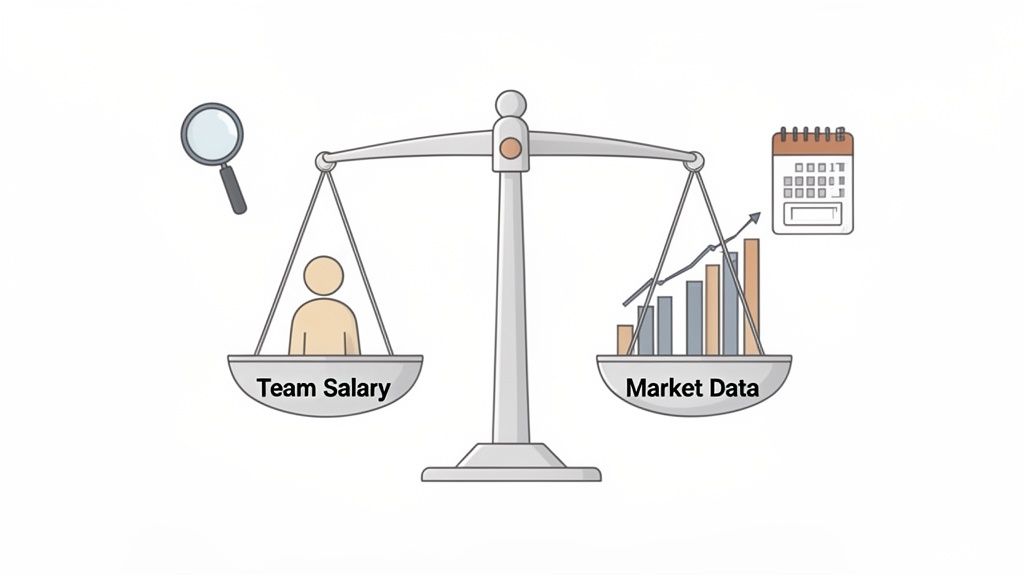
This approach not only ensures fairness but also serves as a powerful retention tool. When employees understand that their compensation is aligned with industry standards, it builds trust and demonstrates the company's commitment to valuing their contributions. For managers, it provides a solid foundation for justifying pay increases, identifying potential flight risks due to under-compensation, and making informed decisions about salary adjustments versus performance-based bonuses. To get started, you can learn more about how salary benchmarking works and integrate it into your review process.
Real-World Examples in Marketing
- A Marketing Director uses a salary benchmarking report and discovers their high-performing SEO Specialist is earning 12% below the market average for their specific skill set and geographic location. Armed with this data, the director successfully advocates for a significant market adjustment during the review cycle, preventing the potential loss of a key team member.
- A Growth Marketing Manager preparing for annual reviews benchmarks their team against roles advertised by direct competitors. They present this data to leadership to justify above-average salary increases for team members who have developed in-demand skills in conversion rate optimization (CRO) and paid social.
How to Implement This Strategy
To effectively integrate this into your process, follow these actionable steps. This is one of the most impactful performance review tips for managers looking to build a fair and competitive compensation structure.
- Prepare in Advance: Pull comprehensive salary benchmark reports 2 to 3 weeks before review season begins. This gives you time to analyze the data and align it with your budget and performance ratings.
- Be Role-Specific: Avoid generic titles. Review data by specialization, such as "Paid Media Manager" or "Content Strategist," not just a broad "Marketing Manager" category, to ensure accuracy.
- Separate the Conversations: Clearly distinguish between a market adjustment (aligning pay with external benchmarks) and a merit increase (rewarding individual performance). This prevents confusion and clarifies the basis for compensation changes.
- Maintain Transparency: Where appropriate, share relevant, anonymized market data with employees. This contextualizes their compensation and shows that decisions are based on objective information, not personal opinion.
- Keep Data Current: The marketing industry evolves quickly. Update your benchmarks annually to stay current with market shifts and new skill demands.
2. Establish Clear, Role-Specific Performance Metrics Aligned with Career Progression
Ambiguity is the enemy of a fair and effective performance review. Establishing clear, measurable, and role-specific metrics before the review period begins eliminates guesswork and provides a transparent framework for evaluation. This approach involves defining exactly what success looks like at each career level, ensuring both managers and employees share a common understanding of expectations.
When metrics are directly tied to career progression, employees can see a clear path forward. They understand precisely what they need to achieve to earn a promotion or a merit increase, transforming the review from a backward-looking judgment into a forward-looking roadmap. This clarity empowers employees to take ownership of their development and gives managers an objective basis for assessing contributions, which is one of the most crucial performance review tips for managers aiming to foster a high-performance culture.
Real-World Examples in Marketing
- A Paid Media Manager has their performance tied to specific, quantitative targets. Achieving a Return on Ad Spend (ROAS) of 4:1 and keeping Cost Per Acquisition (CPA) below $50 might define "meets expectations," while exceeding a 5.5:1 ROAS and reducing CPA to $40 would qualify as "exceeds expectations."
- A Content Marketing Specialist is evaluated on a blend of metrics. Their review includes hitting a quarterly target of 20,000 organic blog visits, maintaining an average time on page of over two minutes, and consistently publishing four high-quality articles per month, as defined by their career level.
- A Growth Marketing Manager is assessed on both quantitative results, like increasing user acquisition by 15% quarter-over-quarter, and qualitative contributions, such as successfully mentoring two junior marketers and leading a cross-functional experimentation initiative.
How to Implement This Strategy
To build a robust system of performance metrics, follow these actionable steps. This process ensures objectivity and aligns individual efforts with broader company goals.
- Collaborate on Metrics: Set goals with your employees at the start of the performance cycle. This co-creation process builds buy-in and ensures metrics feel fair and attainable, avoiding the pitfall of "surprise" criteria during the review itself.
- Balance Quantitative and Qualitative: A great marketer's impact isn't always captured by numbers alone. Include metrics for both hard results (e.g., lead volume, conversion rates) and valuable contributions like innovation, collaboration, and mentorship.
- Document Performance Tiers: Clearly define and document what "Needs Improvement," "Meets Expectations," and "Exceeds Expectations" look like for each key metric before reviews begin. This creates a consistent standard for evaluation.
- Conduct Quarterly Check-ins: Don't wait for the annual review to discuss progress. Use quarterly check-ins to review metrics, make adjustments based on shifting priorities, and provide timely coaching.
- Use Benchmarks to Set Targets: Ground your metrics in reality. Use industry benchmarks and historical performance data to set targets that are challenging but realistic, pushing for growth without causing burnout.
3. Conduct Regular 1-on-1 Check-ins Throughout the Year, Not Just Annual Reviews
Relying on a single annual performance review to manage employee development is like trying to navigate a road trip with only one map check. Shifting to a model of continuous feedback through regular 1-on-1 check-ins transforms performance management from a yearly event into an ongoing dialogue. This approach allows for real-time course correction, early problem-solving, and the cultivation of a stronger, more trusting manager-employee relationship, which is critical in fast-paced marketing environments.
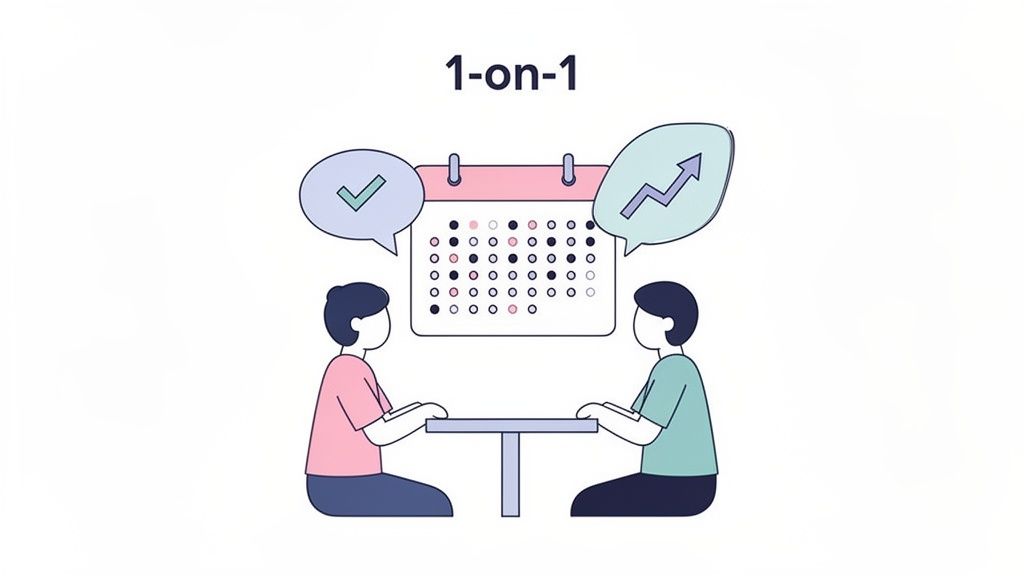
Frequent conversations ensure that by the time the formal annual review arrives, there are no surprises. Both manager and employee have a shared understanding of performance, wins, and areas for growth based on months of consistent communication. This practice turns the annual review into a summary and forward-planning session rather than a stressful, high-stakes reveal. It also provides a structured cadence for check-ins at key milestones, such as in the first few months of a new role, which you can learn more about in a guide to the 90-day review.
Real-World Examples in Marketing
- A Marketing Director holds bi-weekly 15-minute check-ins with their direct reports to discuss campaign progress, roadblocks, and immediate needs. This frequent contact allows them to quickly reallocate resources for a time-sensitive product launch, preventing delays.
- A Growth Team Lead implements quarterly career development conversations. During these sessions, they discuss the skills needed for the next level, align on training opportunities, and touch upon market salary expectations, keeping career progression transparent.
- An Agency Manager uses monthly 1-on-1s to review client satisfaction metrics, workload balance, and team goal alignment. This proactive approach helped them identify burnout risk in a top-performing account manager and adjust their portfolio, leading to improved retention.
How to Implement This Strategy
To make continuous feedback part of your management style, follow these actionable steps. This is one of the most effective performance review tips for managers who want to build proactive and supportive teams.
- Schedule and Protect Time: Book recurring 1-on-1s (weekly or bi-weekly) in the calendar and treat them as non-negotiable. Consistently rescheduling sends a message that the employee's development is not a priority.
- Use a Simple Agenda: Don't overcomplicate it. A simple, employee-led structure works best: What went well? What are the current challenges? What support do you need from me?
- Integrate Broader Topics: Dedicate specific check-ins each quarter to bigger-picture topics. Use these to discuss long-term career goals, professional development, and even preliminary compensation thoughts.
- Document Key Takeaways: Keep brief, shared notes from each conversation. This creates a running log of achievements, challenges, and agreed-upon actions that becomes an invaluable, data-rich resource for the formal annual review.
4. Document Specific Examples and Provide Actionable Feedback
Vague feedback like "good job this quarter" is forgettable and unhelpful. The most effective performance reviews are built on a foundation of specific, documented examples that illustrate an employee's contributions and areas for growth. This practice involves maintaining an ongoing record of performance-related events, both positive and developmental, and using them to deliver concrete, actionable feedback that leaves no room for ambiguity.
By grounding conversations in documented evidence, you reduce the risk of recency bias, where only the last few weeks of performance are remembered. This approach creates a fair and objective process, giving employees a clear picture of their performance over the entire review period. It transforms the review from a subjective judgment into a factual discussion about impact, empowering employees with the precise information they need to replicate successes and improve on challenges.
Real-World Examples in Marketing
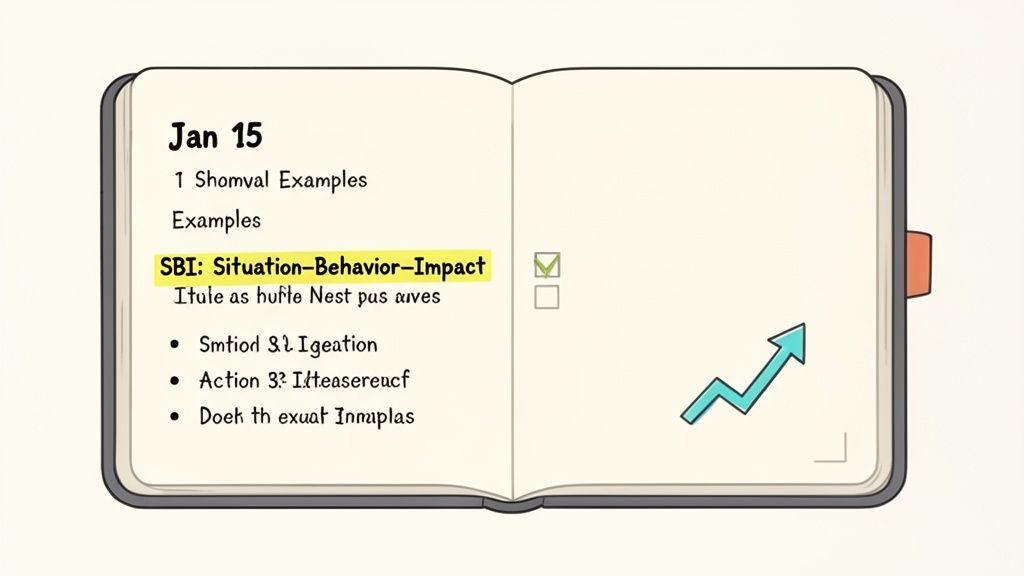
- A Paid Media Manager logs specific events for a specialist: 'Jan 15: Led an optimization that reduced CPA by 18% on the new campaign. June 3: Missed a project deadline due to scope creep, we discussed prioritization strategies. Oct 1: Proactively mentored a junior specialist on our platform strategy.' This provides a balanced view of achievements and developmental moments.
- A Content Director moves beyond simple traffic metrics. Instead of saying, 'Your articles performed well,' they say, 'Your Q3 article on AI trends drove a 15% increase in organic traffic and was cited by two industry publications, establishing our authority. To grow, let's focus next on translating that traffic into marketing-qualified leads.'
How to Implement This Strategy
Integrating this into your routine is one of the most powerful performance review tips for managers who want to deliver impactful feedback.
- Log Examples Regularly: Use a simple spreadsheet, a document, or your HR system to log examples as they happen. A brief monthly check-in is far more effective than trying to recall a year's worth of events right before the review.
- Capture Both Sides: Document both quantitative results (e.g., 'achieved 110% of lead gen target') and qualitative observations (e.g., 'received positive feedback from the sales team on their collaborative approach').
- Use the SBI Framework: Structure your notes and feedback using Situation-Behavior-Impact. Describe the context (Situation), the specific action the employee took (Behavior), and the resulting outcome (Impact). This creates crystal-clear examples.
- Connect Feedback to Growth: Always link your feedback to a development path. Frame it as, 'When you did X, it resulted in Y. To take the next step toward a senior role, focus on Z.'
- Eliminate Surprises: Share documented feedback in real-time during your 1:1s. The formal performance review should be a summary and a planning session, not the first time an employee hears about a significant event.
5. Address Compensation and Career Growth Conversations Separately from Performance Ratings
Combining performance, compensation, and career growth into a single meeting often creates a high-stakes, stressful environment where crucial feedback gets lost. When an employee is anxiously awaiting a salary number, they are less likely to absorb constructive feedback about their performance. Decoupling these discussions allows for focused, productive conversations where each topic receives the attention it deserves, a key strategy among effective performance review tips for managers.
This approach separates the evaluation of past performance from discussions about future compensation and career trajectory. By doing so, you create a space to objectively review achievements and development areas without the immediate pressure of a financial outcome. It transforms the performance review into a genuine coaching session, while subsequent meetings can be dedicated to the distinct, data-driven topics of salary and long-term growth.
Real-World Examples in Marketing
- A VP of Marketing first meets with a high-performing Marketing Manager to discuss their "Exceeds Expectations" rating, focusing entirely on their strategic contributions and leadership skills. Two weeks later, they hold a separate conversation to discuss a salary increase, using market data to explain both a 4% merit raise and a 5% market adjustment.
- An agency formalizes this process by conducting annual performance reviews in March, dedicated compensation reviews in April, and career pathing discussions in May. This structure prevents conversation fatigue and ensures each topic is handled with clarity and focus.
- A Growth Marketing Manager holds a Q4 performance review with a team member, highlighting strong results in a recent campaign and areas for skill development in data analysis. In a separate meeting in Q1, they discuss the new fiscal year's compensation, tying a significant bonus to the previous year's success.
How to Implement This Strategy
To successfully separate these critical conversations, establish a clear and predictable cadence. This structure is one of the most powerful performance review tips for managers aiming to enhance clarity and reduce anxiety for their teams.
- Schedule Deliberately: Hold the performance review first. Schedule the compensation discussion 1 to 2 weeks later, followed by a career development meeting a few weeks after that. This gives time for reflection between each stage.
- Set Clear Agendas: Communicate the purpose of each meeting in advance. For example, "Our meeting on Tuesday is to review your performance over the last six months. We will schedule a separate time next week to discuss compensation for the upcoming year."
- Focus the Conversation: During the performance review, stick strictly to performance feedback, goals, and development opportunities. Defer any questions about salary or promotions to the appropriate, scheduled meeting.
- Document Separately: Keep distinct notes and records for each conversation. Document performance feedback and goals in one place, and compensation decisions or career plans in another, ensuring clear and separate paper trails.
- Maintain Transparency: Explain the "why" to your team. Let them know you are separating the discussions to give each topic the dedicated focus it requires, which ultimately leads to fairer and more thorough outcomes for them.
6. Create Transparent Career Ladders and Promotion Criteria Connected to Market Data
Ambiguity around career growth is a major driver of employee disengagement and turnover. Creating a transparent career ladder removes this uncertainty by clearly outlining the path forward. This practice involves developing and publishing a detailed framework that shows employees the exact progression from their current role to more senior positions, complete with the specific skills, responsibilities, and performance milestones required at each level.
Connecting this framework to market data transforms it from a simple organizational chart into a powerful motivational tool. When each level is associated with a clear compensation band backed by external benchmarks, employees can see how their growth directly translates into financial rewards. This demystifies promotions, making performance reviews less about guessing what management wants and more about collaboratively planning the employee’s next steps on a pre-defined path. You can explore a detailed marketing career path roadmap to see how these structures are built.
Real-World Examples in Marketing
- A digital marketing agency publishes a career ladder for its SEO team: SEO Specialist I ($65k-$85k) → SEO Specialist II ($80k-$100k) → Senior SEO Strategist ($95k-$120k). To advance, a Specialist I must demonstrate proficiency in technical audits, while a Specialist II must successfully lead a multi-channel campaign strategy.
- A B2B SaaS company defines the path for its content team: Content Writer → Senior Content Writer → Content Marketing Lead. The framework specifies that a Senior Writer is expected to mentor junior writers and contribute to the editorial calendar, while the Lead is responsible for the entire content strategy and budget.
How to Implement This Strategy
To make career progression a core part of your management toolkit, follow these actionable steps. This is one of the most effective performance review tips for managers who want to retain top talent long-term.
- Define Core Competencies: For each role level, identify 3 to 5 core competencies (e.g., "Campaign Execution," "Client Communication," "Strategic Planning"). Create clear definitions for what "meets expectations" and "exceeds expectations" looks like for each one.
- Map Real-World Progression: Base your career ladder on realistic growth patterns within your organization, not a generic template. Include both individual contributor and management tracks to provide multiple avenues for advancement.
- Show, Don't Just Tell: Include concrete examples of work and impact expected at each level. For instance, a Junior Paid Media Specialist might manage a $10k/month budget, while a Senior Specialist is expected to manage a $100k+/month budget and report directly to stakeholders.
- Integrate Market Data: Use compensation benchmarking tools to assign a competitive salary band to each level of your career ladder. This ensures your internal progression keeps pace with the external market.
- Make it Accessible: Share the career ladder framework with all team members during onboarding and revisit it during every performance review. This makes it a living document that guides development conversations.
7. Gather 360-Degree Feedback and Peer Input to Reduce Bias in Performance Assessment
A manager’s perspective is crucial, but it’s only one part of the story. Relying solely on a single viewpoint can introduce unconscious bias and overlook key contributions. Gathering 360-degree feedback broadens the assessment by incorporating structured input from peers, direct reports, and cross-functional partners, creating a holistic and more objective picture of an employee's impact.
This method moves beyond a top-down evaluation to a comprehensive review of how an individual collaborates, communicates, and contributes across the organization. It uncovers blind spots a manager might miss, such as an employee's supportive role on another team or their influence in cross-departmental projects. This balanced view ensures that the final evaluation is a fair reflection of their overall performance, not just their direct interactions with you.
Real-World Examples in Marketing
- A Growth Marketing Manager participates in a 360-degree review, receiving feedback from their direct manager, two peer managers, three team members, and a key partner in the finance department. The aggregated feedback highlights their exceptional strategic planning skills but also identifies a consistent theme: a need to improve active listening during collaborative meetings.
- A Content Marketing Specialist gathers input from her manager, two peer writers, and the sales enablement lead she frequently supports. The feedback validates her strong writing and research abilities but also reveals an opportunity to improve communication around timelines for content revisions, providing a clear area for professional development.
How to Implement This Strategy
To effectively incorporate 360-degree feedback, a structured approach is essential. This is one of the most powerful performance review tips for managers who want to foster a culture of comprehensive and fair evaluation.
- Use Structured Forms: Avoid open-ended questions like "What do you think of Jane?" Instead, use a structured questionnaire that asks respondents to rate specific behaviors and their impact, such as "How effectively does this person incorporate feedback into their work?"
- Ensure Anonymity: Guarantee that all peer and direct report feedback will be anonymized and aggregated. This is critical for encouraging honest, constructive input, as respondents will feel psychologically safe to share their true perspectives.
- Select Diverse Respondents: Choose a balanced group of reviewers who see different facets of the employee's work. Include direct collaborators, internal clients, and team members to get a well-rounded view.
- Synthesize and Summarize: Aggregate the feedback to identify recurring themes and patterns, both positive and constructive. Focus on these trends rather than isolated or outlier comments.
- Share Themes, Not Quotes: During the review, present a summary of the feedback themes to the employee. Avoid sharing raw, individual responses to protect anonymity and keep the conversation focused on actionable development areas.
8. Create Development Plans with Skills Mapping and Market-Based Growth Opportunities
A performance review should be as much about the future as it is about the past. By creating development plans tied to skills mapping and market-based growth opportunities, you transform the conversation from a simple evaluation into a collaborative career strategy session. This approach involves identifying an employee's career aspirations, mapping the skills required for their desired next role, and using real market data to illustrate the tangible rewards of their professional growth.
This strategy powerfully connects an individual's daily work to their long-term ambitions, providing a clear and motivating roadmap. It shows employees that the company is invested in their journey, not just their immediate output. For managers, this is one of the most effective performance review tips for managers to boost retention and engagement, as it gives team members a concrete vision of their future within the organization, complete with timelines and potential compensation milestones.
Real-World Examples in Marketing
- A Paid Media Specialist expresses a desire to become a Growth Marketing Manager. Their manager helps build a development plan that includes: taking a growth strategy course (3-month goal), leading one full-funnel campaign optimization project (6-month goal), and mentoring a junior specialist (ongoing). The plan outlines a potential timeline of 18 months to be ready for the manager role, with an associated salary path from $72,000 to a target of $125,000.
- A Content Writer aspires to a Content Manager position. Their plan focuses on an advanced analytics certification to better measure content impact, taking editorial leadership on a key content series, and mentoring a new writer. This 12 to 18-month plan shows a clear path to promotion and a potential salary increase from $58,000 to $95,000.
How to Implement This Strategy
To make development planning a cornerstone of your review process, follow these actionable steps. To ensure these plans lead to profound and lasting improvements, managers can explore the principles of What is Transformational Coaching.
- Start with the Goal: Begin the development discussion by asking, "What does your next ideal role look like, here or elsewhere?" This opens an honest conversation about their aspirations.
- Map the Gaps: Pull up a job description for their desired future role. Collaboratively map their current skills against the required competencies to identify the 2 to 3 most critical skill gaps to focus on.
- Show the Financial Upside: Use market data to show the typical salary range for the target role. This makes the goal tangible and provides powerful motivation. Frame it as, "Professionals at that level typically earn between X and Y."
- Build Tactics into Daily Work: Integrate development opportunities into their current role through stretch assignments, project leadership roles, or mentoring responsibilities. This makes growth part of the job, not an extra task.
- Schedule Quarterly Check-Ins: Don't wait a full year to review progress. Set up brief, quarterly check-ins to discuss their development plan, celebrate milestones, and adjust the strategy as needed.
8-Point Performance Review Comparison
| Practice | Complexity & Process 🔄 | Resource & Time ⚡ | Expected Outcomes 📊 | Ideal Use Cases 💡 | Key Advantages ⭐ |
|---|---|---|---|---|---|
| Use Data-Driven Compensation Benchmarking During Reviews | Moderate — requires benchmarking tools and periodic updates | Subscription/data pulls + manager prep (2–3 weeks before reviews) | Market-aligned pay, reduced attrition, defensible raises | Compensation planning, annual reviews, retention risk cases | Objective pay decisions; transparency; competitive hiring |
| Establish Clear, Role-Specific Performance Metrics Aligned with Career Progression | High — needs design of role KPIs and ongoing refinement | Time to define KPIs, align stakeholders, quarterly reviews | More objective evaluations, clear promotion criteria, reduced bias | Metric-driven functions (paid media, SEO, growth) and career ladders | Clarity on expectations; easier promotion and calibration |
| Conduct Regular 1-on-1 Check-ins Throughout the Year | Low structural complexity; high recurring time commitment | Recurring manager time (monthly/quarterly); simple templates | Increased engagement, early issue detection, better review context | Fast-moving teams, remote/hybrid, development-focused managers | Continuous feedback; stronger manager-employee relationships |
| Document Specific Examples and Provide Actionable Feedback | Moderate — requires discipline and a documentation system | Ongoing note-taking or HR tool; periodic synthesis | Reduced recency bias, concrete development actions, evidence-based ratings | Teams needing objective evidence for promotions and performance actions | Specific, actionable feedback; improves behavior change and fairness |
| Address Compensation and Career Growth Conversations Separately from Performance Ratings | Moderate — scheduling and clear communication required | Multiple meetings; HR coordination and preparation | Clearer, less defensive conversations; fairer pay decisions | Organizations with complex pay structures or sensitive raises | Decouples pay from ratings; clearer rationale for compensation moves |
| Create Transparent Career Ladders and Promotion Criteria Connected to Market Data | High — significant upfront framework design and maintenance | Substantial documentation effort; periodic market updates | Improved retention, transparent progression, aligned compensation | Scaling orgs, agencies, long-term retention and hiring clarity | Transparency in advancement; reduces perceived favoritism; market alignment |
| Gather 360-Degree Feedback and Peer Input to Reduce Bias | High — administration, anonymity safeguards, synthesis needed | Time from many respondents; tooling for aggregation and analysis | Broader performance perspective, identifies blind spots, validates impact | Leadership development, cross-functional roles, senior evaluations | Reduces manager bias; multi-source validation of performance |
| Create Development Plans with Skills Mapping and Market-Based Growth Opportunities | Moderate — requires skill mapping and manager commitment | Manager time, possible training budget, regular progress check-ins | Clear growth paths, measurable skill gains, demonstrated pay upside | High-potential employees, succession planning, early-career development | Links development to compensation; accountability and retention benefit |
Building a Culture of Continuous Growth and Fair Recognition
The journey from a traditional, often dreaded annual review to a dynamic, year-round performance dialogue is a strategic imperative for modern marketing leaders. The performance review tips for managers we've explored are not just individual tactics; they are interconnected components of a larger system designed to foster transparency, fairness, and continuous professional development. By moving beyond a single, high-stakes meeting, you transform performance management from a retrospective judgment into a forward-looking partnership.
This shift requires a fundamental change in mindset. Instead of viewing reviews as an administrative hurdle, see them as the culmination of an ongoing conversation. The real work happens in the consistent documentation of achievements, the regular 1-on-1 check-ins that prevent surprises, and the collaborative creation of development plans that align individual ambitions with organizational needs. When you separate discussions about performance feedback from conversations about compensation, you create the psychological safety needed for genuine, constructive dialogue.
Key Takeaways for Immediate Impact
To truly elevate your approach, focus on integrating these core principles into your management rhythm:
- Data Over Subjectivity: Ground your decisions in objective reality. This means using clear, role-specific metrics to evaluate performance and leveraging external market data for compensation and career pathing. This data-driven approach minimizes unconscious bias and builds trust.
- Transparency as the Default: Vague expectations and secret promotion criteria are relics of the past. Transparent career ladders, clear performance metrics, and open conversations about what it takes to advance are non-negotiable for retaining top marketing talent today.
- Continuous Feedback Loop: The annual review should be a summary, not a reveal. By implementing 360-degree feedback and maintaining a steady cadence of informal and formal check-ins, you create a culture where feedback is a normal, expected, and valued part of the work week.
Your Action Plan: From Theory to Practice
Mastering these performance review tips for managers is an investment that pays dividends in team morale, retention, and business outcomes. The goal is to build an ecosystem where every team member, from a Paid Media Specialist analyzing campaign data to a Content Director shaping brand narrative, understands exactly how their contributions are measured and valued. They see a clear, attainable path for growth within the organization, backed by fair and competitive compensation.
This system empowers your team members to take ownership of their careers. They become active participants in their own development rather than passive recipients of a yearly rating. For you as a manager, this approach reduces the stress of difficult conversations, simplifies decision-making around promotions and raises, and ultimately equips you to build a resilient, high-performing marketing engine. You are no longer just a manager; you are a coach, a strategist, and a key architect of your company's talent pipeline. The result is a team that isn't just meeting expectations but is actively engaged in exceeding them, confident that their growth and success are intrinsically linked to the company's.
Ready to anchor your performance reviews and compensation strategy in real-world data? Use SalaryGuide to access up-to-the-minute benchmarks for marketing roles, ensuring your compensation decisions are fair, competitive, and transparent. Explore the SalaryGuide today to build a team that feels valued and sees a clear future with your company.
