Interview Questions About Time Management: Top Answers for Your Next Role
In the fast-paced world of marketing, time management isn't just a soft skill; it's the core competency that separates high-impact performers from the perpetually overwhelmed. From managing simultaneous campaign launches to balancing strategic planning with urgent firefighting, how you handle your priorities determines your success. Hiring managers know this, which is why interview questions about time management are no longer a formality. They are a critical test of your organizational maturity, strategic thinking, and ability to deliver results under pressure.
This comprehensive guide is designed to help you master these crucial conversations. We will dissect the most common and challenging questions that hiring managers use to evaluate your time management capabilities. You won’t find generic advice here. Instead, you'll get a detailed playbook for demonstrating your ability to prioritize tasks, manage competing deadlines, and maintain focus in a dynamic marketing environment.
This article provides a framework for answering each question, complete with:
- Model answers structured using the STAR method.
- Insights into what interviewers are really looking for.
- Follow-up questions you should anticipate.
- Actionable tips for showcasing your value as a reliable, high-impact candidate.
By understanding the strategy behind these questions and preparing your own specific examples, you'll be equipped to prove that your time management skills are as strong as your marketing expertise. You will learn how to transform a simple question into a powerful demonstration of your professional competence, helping you stand out and land that next great marketing role.
1. Tell me about a time when you had to manage multiple marketing campaigns simultaneously. How did you prioritize your work?
This behavioral question is a staple in marketing interviews because it directly probes a candidate's ability to juggle the complex, overlapping demands of modern marketing. Interviewers use this prompt to assess how you handle pressure, competing deadlines, and strategic resource allocation in a real-world context. It moves beyond theoretical knowledge to reveal your practical project management and prioritization skills, which are crucial when managing diverse channels like paid media, SEO, content, and social media.
Your answer demonstrates not just what you did, but why you did it. It gives insight into your strategic thinking, your ability to align daily tasks with broader business goals, and your communication style when priorities shift. A strong response showcases a clear methodology, tactical execution, and an understanding of business impact.

How to Structure Your Answer
A compelling answer to this common interview question about time management should follow a clear narrative structure. The STAR (Situation, Task, Action, Result) method is particularly effective here.
- Situation: Briefly describe the context. For example, a growth marketer juggling an in-depth SEO audit, a new PPC campaign launch, and an email nurture sequence redesign simultaneously.
- Task: Clearly state your objective. What was the goal you needed to achieve amidst these competing projects?
- Action: This is the core of your answer. Detail the specific steps you took to prioritize. Explain your framework, such as an impact/effort matrix, revenue potential, or dependency on other teams. Mention the tools you used, like Asana or Jira, to track progress.
- Result: Quantify the outcome. Explain how your prioritization led to successful campaign launches, met deadlines, and positively impacted key business metrics like lead generation or revenue.
Pro Tip: Don't just list your tasks. Explain your prioritization logic. Did you use the Eisenhower Matrix (urgent/important)? Did you score tasks based on potential ROI? Explicitly naming your methodology shows a sophisticated approach to time management.
Preparing Your Example
To make your answer stand out, prepare a specific, data-backed story. Be ready to discuss the challenges you faced, such as unexpected delays or resource constraints, and how you navigated them. Highlighting your communication with stakeholders to manage expectations or re-align priorities demonstrates maturity and leadership potential. This level of detail provides concrete evidence of your ability to perform under pressure.
2. Describe a situation where you missed a deadline or failed to manage your time effectively. How did you handle it and what did you learn?
This behavioral question tests a candidate's self-awareness, accountability, and capacity for growth. Interviewers ask this to see how you respond to setbacks and whether you possess the maturity to learn from your mistakes. It's a powerful tool to differentiate candidates who blame external factors from those who take ownership and proactively improve their processes. In high-stakes marketing roles, a missed deadline can derail a campaign launch, so demonstrating resilience and a commitment to improvement is vital.
Your answer reveals your problem-solving skills under pressure and your ability to implement lasting solutions. It’s a chance to show you’re not just effective when things go right, but also reflective and resourceful when they go wrong. A strong response demonstrates honesty, a systematic approach to self-correction, and the humility to turn a failure into a valuable learning experience.
How to Structure Your Answer
To address this delicate interview question about time management, use a modified STAR method that emphasizes accountability and learning. The focus should be on resolution and growth.
- Situation: Briefly set the scene. Describe a real, but not catastrophic, scenario. For instance, a content marketer missing a blog publishing deadline due to poor coordination with the design team.
- Task: State your responsibility and the specific deadline you missed. Acknowledge the potential impact, such as delaying a social media campaign tied to the content.
- Action: Detail the immediate steps you took to mitigate the damage (e.g., communicating the delay to stakeholders, creating a revised timeline). Then, describe the long-term, systemic changes you implemented. This could be adopting a new project management tool, setting up an editorial calendar with buffer time, or establishing a clearer review process.
- Result: Explain the positive outcome of your changes. Quantify the improvement if possible, such as "After implementing a two-week buffer and weekly check-ins, our content team has hit 100% of deadlines for the past two quarters."
Pro Tip: Take full ownership. Avoid blaming others or external circumstances. Frame the story around what you learned and how you changed your approach. Saying "I misjudged the time needed for approvals" is much stronger than "The design team was slow."
Preparing Your Example
Choose your example wisely. It should be a genuine mistake with a clear lesson, not a career-ending failure. Be ready to explain the root cause of the time management failure, was it poor planning, overcommitment, or an inefficient workflow? Highlighting how you now use specific techniques like time-blocking, automated reporting dashboards, or a peer-review process provides concrete proof of your growth. This kind of preparation shows you are a reflective professional who is committed to continuous improvement, a key trait for any role. As you get ready, it's also useful to learn more about how to prepare for an interview to build a comprehensive strategy.
3. How do you approach planning your week or month? Walk me through your time management system and tools you use.
This direct question moves beyond specific scenarios to evaluate your entire organizational framework. Interviewers use it to distinguish between candidates who are merely reactive and those who are proactively strategic. Your answer reveals your personal accountability, foresight, and whether you possess a scalable system for managing complexity, which is essential for growth in any marketing role.
This prompt provides a window into your daily habits, your proficiency with modern productivity tools, and how you translate high-level goals into actionable weekly tasks. A strong response demonstrates a repeatable, intentional process, not just a haphazard list of to-dos. It shows the interviewer that you are a self-managed professional who can be trusted with significant responsibilities.
How to Structure Your Answer
When answering this question, a structured, top-down approach works best. Start with your high-level planning cadence and drill down into the daily specifics and tools you use.
- High-Level Strategy (Quarterly/Monthly): Begin by explaining how you align your work with broader company objectives, like quarterly OKRs. Mention how you break these down into monthly milestones.
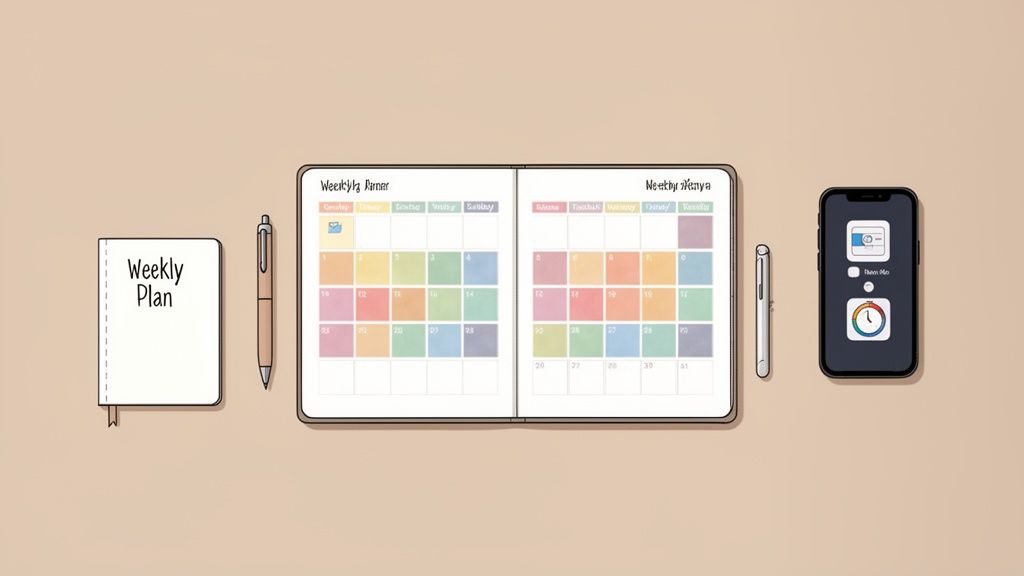
- Weekly Execution (The Core System): Detail your weekly planning ritual. For instance, you might dedicate 30 minutes every Sunday or Monday morning to review priorities, block your calendar, and set key goals for the week.
- Daily Tactics & Tools: Explain how you manage your day-to-day. Mention specific tools (e.g., Asana for team projects, Notion for personal notes, Google Calendar for time blocking) and daily habits like a 15-minute morning check-in.
- Adaptability: Conclude by explaining how your system allows for flexibility. How do you handle urgent, unplanned requests without derailing your entire week? This shows you are both organized and agile.
Pro Tip: Name the specific tools you use and explain why you chose them. Saying "I use Asana to track dependencies with the design team and Monday.com for my content calendar" is far more impactful than a generic "I use project management software."
Preparing Your Example
Your goal is to paint a clear picture of an organized, efficient professional. Before the interview, outline your actual planning process. If you don't have a formal one, now is the perfect time to create one based on best practices. Be prepared to discuss how your system helps you not just manage tasks, but also protect your focus. While traditional time management focuses on scheduling, a more modern and effective approach emphasizes managing energy not time to boost focus and prevent burnout. Mentioning how you time-block for deep work or batch similar tasks shows a sophisticated understanding of personal productivity. Your system should sound like a well-oiled machine that drives consistent results.
4. Tell me about a time when you had to say 'no' to work or a project request. How did you decide what to decline?
This behavioral question assesses a candidate's ability to set strategic boundaries, a crucial but often overlooked time management skill. Interviewers use it to gauge your understanding of opportunity cost, your political acumen, and your capacity to protect your focus for high-impact initiatives. It reveals whether you operate from a clear set of priorities aligned with business goals or simply react to the loudest request.
In marketing, where requests from sales, product, and leadership are constant, the ability to say 'no' gracefully is what separates a truly effective strategist from an overwhelmed task-doer. A strong answer demonstrates that you are not just a hard worker, but a smart one who can defend your team’s capacity and align your efforts with what truly moves the needle.
How to Structure Your Answer
To effectively answer this interview question about time management, use the STAR method to frame your story. This provides a clear, logical narrative that showcases your strategic thinking and communication skills.
- Situation: Briefly set the scene. For example, describe a scenario where you, as a content strategist, were asked to write daily social media posts on top of a major website content overhaul project.
- Task: State the conflict. Your task was to evaluate the new request against your existing high-priority commitments and decide whether to accept, delegate, or decline it.
- Action: Detail your thought process and communication. Explain the framework you used to make the decision, such as evaluating the request's alignment with quarterly OKRs, its potential ROI versus its time cost, or your team’s current bandwidth. Describe how you communicated your decision respectfully, offering data-backed reasons and potentially suggesting an alternative solution.
- Result: Quantify the positive outcome of your decision. Explain how by declining the smaller task, you were able to deliver the high-impact project on time, leading to a significant increase in organic traffic or lead conversions.
Pro Tip: Your rationale is more important than the 'no' itself. Clearly articulate your decision-making framework. Did you decline because the request didn't align with company goals, offered low ROI, or fell outside your core expertise? Explaining the why shows strategic maturity.
Preparing Your Example
Choose a real-world example where your decision to decline a request was clearly justified and ultimately benefited the business. The ability to effectively decline requests, such as learning how to say no to a meeting, is a critical skill in managing your workload and protecting your time. Be ready to explain how you managed the relationship with the requester, perhaps by offering an alternative solution, providing data to support your decision, or suggesting a different timeline. This demonstrates that you can maintain positive stakeholder relationships even when you can't fulfill every request.
5. Describe a project where you had to manage your time across strategic work and urgent firefighting. How did you balance both?
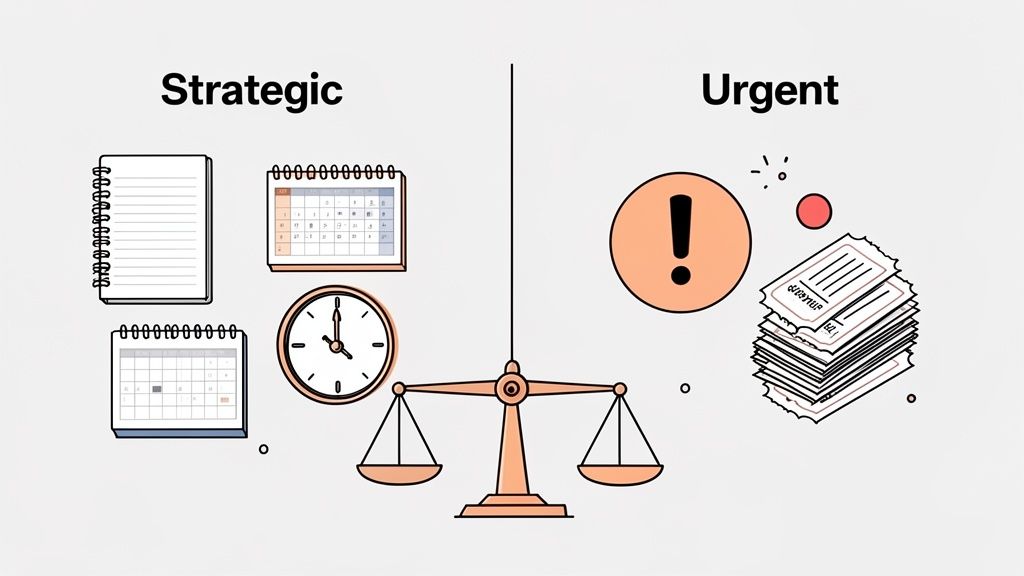
This behavioral question gets to the heart of a constant struggle in marketing: balancing important, long-term strategic work with the daily barrage of urgent, reactive tasks. Interviewers use this to see if a candidate can protect high-value activities from being derailed by "firefighting." It distinguishes between professionals who build resilient systems and those who are perpetually overwhelmed by the immediate.
Your response reveals your ability to maintain focus on big-picture goals while effectively managing crises. For any marketing role, from a content strategist redesigning a content calendar during a brand emergency to a growth marketer defending a six-month roadmap against daily optimization demands, this skill is paramount. It's a key indicator of leadership potential and strategic thinking.
How to Structure Your Answer
The STAR (Situation, Task, Action, Result) framework is ideal for framing your response to this challenging time management question. It helps you tell a clear and compelling story.
- Situation: Briefly set the scene. For example, a marketing manager was tasked with building a new lead scoring model while simultaneously dealing with urgent performance issues in a major Q4 campaign.
- Task: Define your dual objectives. The goal was to complete the strategic lead scoring project without letting the critical Q4 campaign fail.
- Action: This is the most critical part. Detail the system you created to manage this conflict. Did you block out specific "deep work" time? Did you delegate urgent tasks? Mention specific processes, like creating templates for common urgent requests or establishing a triage system for incoming issues.
- Result: Quantify the outcome. Explain how your approach allowed you to make significant progress on the strategic project and stabilize the urgent campaign, citing metrics for both if possible.
Pro Tip: Acknowledge the tension. Don't pretend you found a perfect, effortless balance. Show self-awareness by explaining that it was a challenge and that your system was a deliberate response to that challenge. This makes your answer more realistic and credible.
Preparing Your Example
Choose a story with genuine conflict between strategy and urgency. Be prepared to explain the specific boundaries you set. For instance, describe how you communicated your time allocation (e.g., "I dedicated 10 hours a week, every Tuesday and Thursday morning, to the strategic project") to stakeholders to manage their expectations. Highlighting how you protected that time demonstrates maturity and the ability to develop strong leadership skills by prioritizing long-term business impact over short-term reactivity. This shows you can not only do the work but also create the conditions necessary for strategic success.
6. Tell me about a time when you had to get a project done quickly with limited resources. How did you manage your time and what trade-offs did you make?
This behavioral question gets to the heart of real-world marketing: delivering results when time, budget, or people are scarce. Interviewers use this to gauge your resourcefulness, problem-solving skills, and ability to make pragmatic decisions under pressure. It reveals whether you can differentiate between "perfect" and "done" and focus on activities that drive the most impact with limited means.
Your answer demonstrates your ability to think creatively and strategically, not just execute a perfect plan. For marketing roles, where teams are often lean and goals are ambitious, showing you can deliver value despite constraints is a powerful indicator of your effectiveness. It showcases your prioritization logic, communication skills, and focus on business outcomes.
How to Structure Your Answer
To effectively answer this common interview question about time management, use a clear narrative framework like the STAR method to guide your story.
- Situation: Briefly set the scene. For example, a content marketer tasked with creating a comprehensive 10-piece asset package in one week instead of the usual three due to a surprise product launch.
- Task: Define your specific objective. What was the core goal you had to achieve with these constraints? The task was to deliver a high-impact content kit to support the launch on a tight deadline.
- Action: This is the most critical part. Detail the steps you took. Explain how you prioritized, what you decided to cut, and what you automated. For instance, you might have partnered with a designer to create scalable templates, prioritized the "hero" assets like a blog post and an infographic, and scaled back on less critical variations. Mention any tools used to accelerate the process.
- Result: Quantify the outcome. Explain how your strategic trade-offs led to a successful launch. Did the hero content pieces perform well? Did you meet the deadline and support the sales team effectively? Show the positive business impact of your decisions.
Pro Tip: Be completely transparent about the trade-offs. Explaining what you chose not to do and why is as important as explaining what you did. For example, "We sacrificed in-depth keyword research on secondary assets to focus all our SEO efforts on the main pillar page, knowing that would drive 80% of the initial traffic."
Preparing Your Example
Choose a specific story where the constraints were real, not self-imposed. Be ready to articulate your decision-making process clearly. Why did you choose to focus on certain channels or assets? How did you communicate these necessary trade-offs to stakeholders to manage their expectations upfront? Highlighting this communication piece shows maturity and an understanding of team dynamics. Reflect on what you might do differently if you had more resources; this demonstrates critical thinking and a desire for continuous improvement.
7. How do you stay organized and ensure nothing falls through the cracks when managing a large number of tasks, projects, or client accounts?
This behavioral question assesses your organizational systems and professional reliability. Interviewers ask this to see if you have a scalable, repeatable process for managing complexity or if you simply rely on memory and last-minute effort. It reveals your ability to build trust and operate effectively as your responsibilities grow.
For marketing professionals juggling multiple campaigns, client accounts, or stakeholder relationships, having a robust system is non-negotiable. It ensures consistency, prevents costly errors, and builds a reputation as a dependable operator. This question helps hiring managers distinguish between candidates who can manage a current workload and those who can scale to meet future demands.
How to Structure Your Answer
Your answer should describe a tangible system, not just good intentions. Use the STAR method to frame your example, focusing heavily on the "Action" component to detail your methodology and the tools you use.
- Situation: Describe a scenario where you were responsible for a high volume of work. For instance, an account manager handling eight distinct client accounts, each with its own set of deliverables and timelines.
- Task: State your primary goal. For example, your task was to deliver all client work on time and to a high standard, while maintaining proactive communication and ensuring no critical deadlines were missed.
- Action: Detail your organizational system. Explain the specific tools (like Asana, Jira, or even a sophisticated spreadsheet) and the processes you built around them. Mention how you categorized tasks, used automated reminders, and scheduled regular check-ins to monitor progress.
- Result: Share the positive outcome of your system. This could be achieving a 100% on-time delivery rate for a quarter, improving client satisfaction scores, or successfully scaling your workload without a drop in quality.
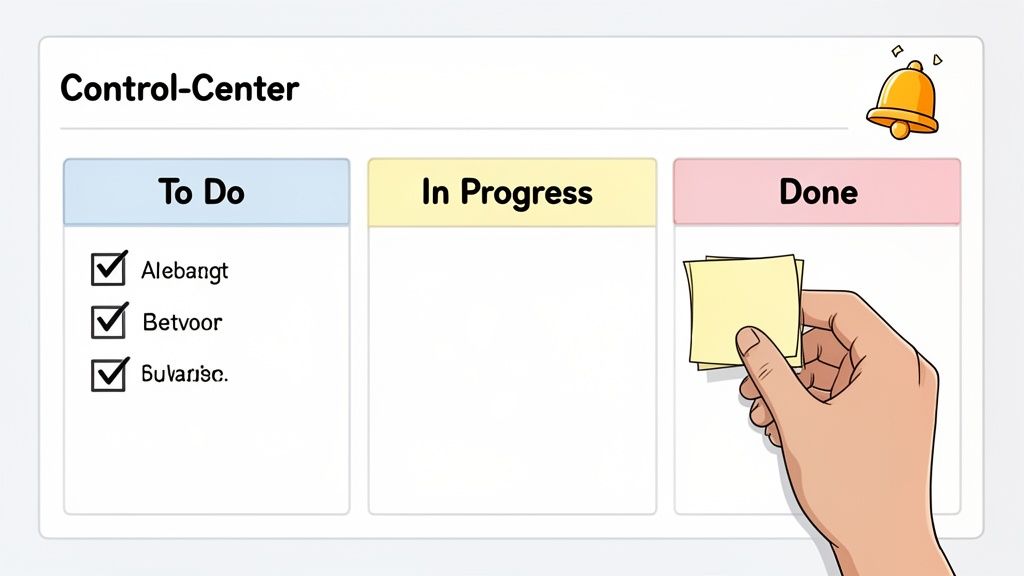
Pro Tip: Name your system. Calling it your "Control Center," "Master Tracker," or "Weekly Accountability Loop" makes your method sound intentional and professional. It shows you've consciously designed a process rather than just falling into a routine.
Preparing Your Example
Go beyond just listing tools. Explain how and why your system works. Be prepared to discuss how it helps you identify bottlenecks, how it scales when you take on more projects, and how it facilitates communication with your team and stakeholders. For example, explain how color-coding projects in Asana gives you an immediate visual cue about priorities or how automated Slack reminders reduce the mental load of tracking minor follow-ups. Providing this level of detail offers concrete proof of your organizational prowess.
8. Tell me about a time when you had to re-prioritize your work unexpectedly. How did you handle the shift and manage the impact?
This behavioral question assesses adaptability, communication, and resilience. In the fast-paced world of marketing, priorities can shift overnight due to market changes, new executive directives, or competitive pressures. Interviewers use this prompt to see how you react to disruption and distinguish between candidates who can pivot gracefully and those who become rigid or flustered.
Your answer reveals your problem-solving process under pressure. It shows if you can maintain a positive, proactive mindset while managing the practical fallout of a sudden change. For leadership roles, it’s a critical test of your ability to guide a team through uncertainty, manage stakeholder expectations, and realign resources effectively without derailing morale or long-term goals.
How to Structure Your Answer
The STAR (Situation, Task, Action, Result) method is ideal for framing your response, as it provides a clear, logical narrative that showcases your crisis-management skills.
- Situation: Briefly set the scene. Describe a project or plan that was proceeding as expected. For example, a content strategist executing a six-month content calendar focused on organic growth.
- Task: Explain the unexpected shift. What was the new, urgent priority that disrupted your original plan? For instance, a sudden C-suite decision to launch a new product in two months, requiring an immediate pivot in all content creation.
- Action: This is where you shine. Detail your step-by-step response. Explain how you assessed the impact, communicated the change to your team and stakeholders, and reallocated resources. Did you pause existing work, delegate new tasks, or negotiate new timelines?
- Result: Quantify the outcome of your actions. Explain how your swift re-prioritization successfully supported the new objective while minimizing disruption to other goals. For example, "We successfully launched the new product content on time, leading to X sign-ups in the first month, while creating a revised roadmap for our original SEO goals."
Pro Tip: Focus on your communication strategy. Explain how you conveyed the change to your team and stakeholders. Demonstrating that you can manage expectations, explain the "why" behind the shift, and maintain team alignment is just as important as the tactical changes you made.
Preparing Your Example
Choose a real-world scenario where the reason for the shift was a legitimate business need, not just poor planning. Be ready to articulate your thought process: how you evaluated the trade-offs, managed any frustrations (your own or your team's), and ultimately embraced the new direction. Highlighting any lessons learned about building more flexible plans in the future will show a commitment to continuous improvement. This approach turns a potentially negative event into a powerful story of your professional maturity and strategic thinking.
8-Question Time Management Interview Comparison
| Question | Implementation complexity 🔄 | Resource requirements ⚡ | Expected outcomes 📊 | Ideal use cases 💡 | Key advantages ⭐ |
|---|---|---|---|---|---|
| Tell me about a time when you had to manage multiple marketing campaigns simultaneously. How did you prioritize your work? | 🔄 Moderate — coordinate interdependent channels and timelines | ⚡ Medium — cross-functional time, planning tools (Asana, spreadsheets) | 📊 Shows prioritization frameworks and ROI-driven delivery | 💡 Multi-channel managers (paid media, SEO, content) | ⭐ Reveals decision frameworks, delegation, stakeholder communication |
| Describe a situation where you missed a deadline or failed to manage your time effectively. How did you handle it and what did you learn? | 🔄 Low–Moderate — candid narrative plus corrective steps | ⚡ Low — requires honest example and remediation plan | 📊 Demonstrates accountability, learning, and process improvements | 💡 Assessing ownership and growth mindset | ⭐ Highlights responsibility, corrective systems, improved outcomes |
| How do you approach planning your week or month? Walk me through your time management system and tools you use. | 🔄 Moderate — outline rhythm, tools, and dependencies | ⚡ Medium — uses planning tools and dedicated planning time | 📊 Shows organizational maturity and scalability of approach | 💡 Manager/director roles that need predictable planning | ⭐ Reveals proactive systems, tool proficiency, measurable routines |
| Tell me about a time when you had to say 'no' to work or a project request. How did you decide what to decline? | 🔄 Moderate — explain political awareness and rationale | ⚡ Low — needs examples of communication and framework | 📊 Evidence of boundary-setting and ROI/alignment decisions | 💡 Mid/senior roles with many stakeholder requests | ⭐ Demonstrates strategic prioritization and stakeholder management |
| Describe a project where you had to manage your time across strategic work and urgent firefighting. How did you balance both? | 🔄 High — explain time protection and delegation systems | ⚡ Medium — time-blocking, delegation, templated processes | 📊 Shows ability to sustain long-term initiatives while handling crises | 💡 Roles requiring both strategy and hands-on execution | ⭐ Reveals discipline, crisis handling, and trade-off management |
| Tell me about a time when you had to get a project done quickly with limited resources. How did you manage your time and what trade-offs did you make? | 🔄 Moderate — describe prioritization and shortcuts used | ⚡ Low–Medium — automation, templates, partner leverage | 📊 Demonstrates resourcefulness, prioritized scope, and impact | 💡 Agency or growth-stage roles with tight timelines/budgets | ⭐ Shows creativity, pragmatic trade-offs, measurable results |
| How do you stay organized and ensure nothing falls through the cracks when managing a large number of tasks, projects, or client accounts? | 🔄 Moderate — explain scalable systems and documentation | ⚡ Medium — requires tools (Kanban, Asana), automation, reviews | 📊 Evidence of reliability, fewer missed deliverables, clearer handoffs | 💡 Account managers, ops, and multi-account marketers | ⭐ Highlights system-thinking, documentation, and consistency |
| Tell me about a time when you had to re-prioritize your work unexpectedly. How did you handle the shift and manage the impact? | 🔄 Moderate — describe change-management and reprioritization steps | ⚡ Low — rapid replanning and stakeholder alignment needed | 📊 Shows adaptability with minimized disruption to outcomes | 💡 Fast-changing environments and leadership roles | ⭐ Demonstrates resilience, communication, and rapid realignment |
Turn Your Answers Into Job Offers
Mastering the art of answering interview questions about time management goes far beyond simply listing the productivity apps on your phone. It's about demonstrating a sophisticated understanding of how personal organization translates directly into professional impact. Throughout this guide, we've deconstructed the most common and challenging questions hiring managers use to gauge your ability to prioritize, adapt, and execute under pressure. The core lesson is clear: your answers must be more than just claims; they must be compelling narratives backed by evidence.
The strongest candidates don't just say they are organized. They prove it by telling stories that showcase a clear system. They connect their methods for managing multiple campaigns, handling shifting priorities, or saying 'no' strategically to tangible business outcomes like hitting aggressive deadlines, maximizing resource efficiency, and maintaining stakeholder confidence.
Key Takeaways: From Theory to High-Impact Answers
Reflecting on the questions and model answers provided, several critical themes emerge. To truly stand out, ensure your preparation internalizes these core principles:
- Structure is Everything: The STAR (Situation, Task, Action, Result) method isn't just a suggestion; it's a non-negotiable framework for clarity. It forces you to move beyond abstract statements ("I'm good at multitasking") and into concrete, verifiable proof ("I used a Kanban board to manage three concurrent campaigns, which resulted in a 15% increase in lead generation while staying under budget").
- Metrics are Your Best Friend: Numbers cut through the noise. Whenever possible, quantify your results. Did you save time? How much? Did you improve efficiency? By what percentage? Did you complete a project ahead of schedule? By how many days? Concrete data transforms a good story into an unforgettable one.
- Honesty Builds Trust: When asked about a time you missed a deadline, don't deflect or blame. Owning a mistake, articulating the specific lesson learned, and explaining the new process you implemented to prevent a recurrence shows incredible maturity, self-awareness, and a commitment to growth. This is often the answer that hiring managers remember most.
- Tools Are the Means, Not the End: While it's great to mention Asana, Trello, or your preferred project management software, focus on the why behind the tool. Explain how the tool enables your strategic framework for prioritization, not just that you know how to use it. The strategy is the skill; the tool is just the tactic.
Actionable Next Steps to Prepare for Your Interview
Knowing the concepts is one thing; performing flawlessly when the pressure is on is another. Use these steps to bridge that gap:
- Build Your Story Inventory: Don't wait for the interview to think of examples. Proactively write down at least two specific stories from your past experience that align with each of the eight questions covered in this article.
- Rehearse Out Loud: Practice telling your stories. This helps you refine your language, check your timing, and ensure your key points land with confidence and clarity. Record yourself to identify areas for improvement.
- Tailor Your Examples: Before each interview, review the job description. Adapt your stories to emphasize the skills and outcomes most relevant to that specific role. If the job emphasizes cross-functional collaboration, choose a time management story that highlights that skill.
Ultimately, your ability to articulate your time management philosophy is a powerful proxy for your overall effectiveness as a marketing professional. It signals that you are not just a creative or a strategist but a reliable executor who can turn ambitious goals into reality. When you successfully demonstrate this capability, you're not just answering a question; you are making a compelling case for why you are the best candidate to deliver value from day one. Answering interview questions about time management with confidence and precision is your opportunity to prove you are an indispensable asset.
Now that you're equipped to demonstrate your value in an interview, ensure you're pursuing opportunities that recognize and reward your skills. Use the SalaryGuide to explore top marketing roles, benchmark your salary expectations against real-time market data, and find companies that value high-impact professionals like you. Land your next role with the confidence that you're being compensated fairly by visiting SalaryGuide today.
